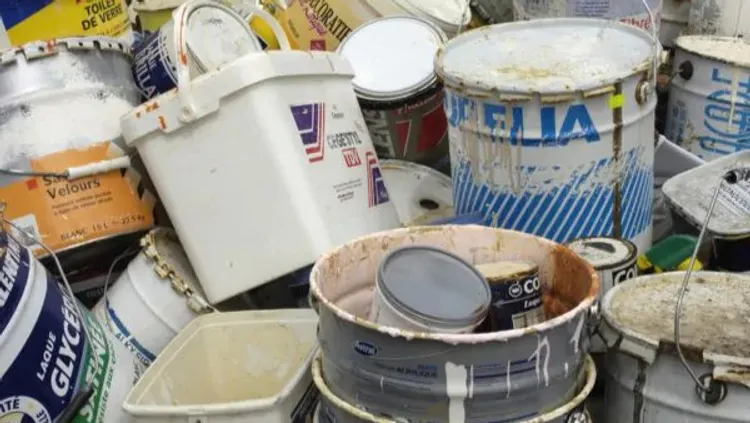
Every garage I’ve ever seen has them. Those half-empty paint cans from projects finished years ago, sitting on a shelf, slowly rusting. After 25 years in waste management, I can tell you paint is one of the most common items people handle incorrectly.
The rules are actually pretty simple once you know the difference between latex and oil-based paint.
Latex vs Oil-Based: How to Tell the Difference
This matters because latex paint is not hazardous waste, but oil-based paint absolutely is. I’ve seen people get hit with fines for dumping oil-based paint down storm drains. Not worth it.
Check the label for these clues:
Latex (water-based) paint:
- Label says “water cleanup” or “soap and water cleanup”
- Usually labeled “acrylic” or “latex”
- Most interior wall paints sold since the 1990s
Oil-based paint:
- Label says “mineral spirits cleanup” or “paint thinner cleanup”
- Often labeled “alkyd” or “oil-based”
- Common in older paints, exterior paints, and most wood stains
If the label is gone or unreadable, add a few drops of water to the paint. If it mixes in, it's latex. If the water beads up on the surface, it's oil-based.
How to Dispose of Latex Paint
Good news: latex paint is not hazardous waste in most states. You can throw it in regular trash, but it needs to be completely dried out first.
The drying method:
-
Less than an inch of paint: Leave the lid off and let it air dry. Takes 2-5 days depending on humidity.
-
More paint in the can: Mix in kitty litter, sawdust, or shredded newspaper. Stir it up and leave the lid off. The absorbent material speeds up drying significantly.
-
Check it’s solid: Poke it with a stick. If nothing sticks, toss the whole can in the trash.
Do this outside or in a well-ventilated garage. The fumes aren't dangerous, but they'll give you a headache. I learned this the hard way in my first apartment.
Some hardware stores sell paint hardener packets that work faster than kitty litter. Usually $2-4 per can. Worth it if you’re clearing out a lot of paint.
How to Dispose of Oil-Based Paint
Oil-based paint is hazardous waste. You cannot put it in the trash, pour it down the drain, or dump it anywhere. The EPA classifies it as ignitable hazardous waste, and violations carry serious fines.
Your options:
1. Household Hazardous Waste (HHW) Collection
Most counties run free HHW collection events a few times per year. Some larger cities have permanent drop-off sites that are open weekly.
Check your county’s waste management website or the EPA’s HHW page for locations and schedules.
2. PaintCare Drop-Off Sites
If you’re in a PaintCare state, you can drop off any paint for free at participating retailers. The PaintCare program covers:
| State | Drop-off Locations |
|---|---|
| California | Most paint and hardware stores |
| Colorado | Sherwin-Williams, Ace Hardware, others |
| Connecticut | Major retailers statewide |
| New York | Benjamin Moore, Sherwin-Williams, local stores |
| Oregon | Home Depot, Lowe’s, local stores |
| Washington | Miller Paint, Sherwin-Williams, others |
Also available in DC, Maine, Minnesota, Rhode Island, and Vermont.
3. Store It Safely Until Collection
If you can’t find a drop-off option right now, store the paint properly:
- Keep the lid sealed tight
- Store away from heat sources and direct sunlight
- Keep in a temperature-controlled area (freezing ruins paint)
- Mark your calendar for the next HHW collection event
What NOT to Do
I've seen all of these violations result in fines or environmental damage. Don't learn the hard way.
Never pour paint down the drain. Latex paint clogs pipes and can mess up water treatment plants. Oil-based paint contaminates water supplies and will destroy your septic system.
Never pour paint on the ground. It seeps into groundwater. In my county alone, we’ve traced three contaminated wells back to someone dumping old paint behind their shed.
Never burn paint. The fumes are toxic, especially from oil-based paint. It’s also illegal in most jurisdictions.
Never put liquid paint in the trash. Even latex paint needs to be dried first. Liquid paint leaks in the garbage truck and contaminates everything else.
Spray Paint Cans
Aerosol cans are a separate category:
- Completely empty: Recycle with regular metal recycling
- Still has product: Treat as hazardous waste
To fully empty a spray can, turn it upside down and spray until only clear gas comes out. That's how you know the product is gone and the can is safe to recycle.
State-Specific Rules
California
California has some of the strictest paint disposal rules in the country. All paint, including latex, should go through PaintCare or HHW collection. The upside: almost every paint retailer accepts old paint for free.
Texas
Texas doesn’t have a statewide paint recycling program, so you’ll need to use HHW collection events or dry out latex paint yourself. Check the TCEQ website for HHW events in your county.
Florida
Florida relies on county HHW programs. Most counties offer collection events monthly. Check the Florida DEP for your local schedule.
New York
New York is part of PaintCare. Most Sherwin-Williams, Benjamin Moore, and local hardware stores accept leftover paint at no charge.
Georgia
My home state. Most metro Atlanta counties (Fulton, DeKalb, Gwinnett, Cobb) run monthly HHW collection. Rural counties usually have quarterly events. Check Georgia facilities for locations.
Disposal Checklist
- Identify paint type (latex vs oil-based)
- For latex: dry it out completely before trashing
- For oil-based: find HHW collection or PaintCare drop-off
- Empty spray cans completely before recycling
- Never pour any paint down drains or on ground
Clearing Out More Than Just Paint?
If you’re doing a full garage cleanout, paint is usually just one piece of the puzzle. You might also be dealing with:
- Old appliances (fridges, AC units with refrigerants)
- Electronics (old TVs, computers)
- Tires
- Motor oil, antifreeze, and other automotive fluids
- Pesticides and lawn chemicals
Most of these need special handling. Your county HHW collection typically accepts all of them on the same day.
The Bottom Line
Latex paint: dry it out, throw it away. Oil-based paint: take it to hazardous waste collection or a PaintCare drop-off site. When in doubt, check your county’s waste management website or call 311.
Use our state directory or interactive map to find disposal facilities near you.
Next time you finish a paint project, write the room name and date on the lid with a Sharpie. Makes it much easier to decide what to keep and what to toss when you're cleaning out years later.